

Same Persona, Different Job: Why Intent Alone Can’t Save Your Marketing
When intent meets intelligence: decoding how products, people, and AI agents recognize each other through Jobs.


Marketers love personas. We give them names, hobbies, and Spotify playlists. We write paragraphs about Emma, 29, who reads The Skimm, drinks matcha, and occasionally doomscrolls before bed.
But Emma doesn’t buy your product because she’s Emma. She buys it because of the progress she’s trying to make in that moment of her life.
And that’s where many marketers get it wrong: we stop at intent, when what we actually need to understand is the job behind it.
Intent is the symptom. The job is the cause.
Intent tells you what someone wants to do. Jobs-to-Be-Done (JTBD) tells you why they want to do it: the deeper progress they’re trying to make.
In JTBD, every action has a trigger, a functional goal, and a desired outcome that represents emotional or social progress.
Let’s look at a real-world example that every product marketer should study: the pregnancy test.
At first glance, every pregnancy-test brand targets the same persona: women of reproductive age.
And on paper, they all share the same intent:
I want to know if I’m pregnant.

But that’s just the surface. Intent is a starting point, not an answer. Now, let’s put the JTBD lens on it:
When I’m missing my period (trigger),
I want to know if I’m pregnant (functional job),
so I can [achieve my desired outcome].
Here’s where the divergence happens:
Job 1: Hope
…so I can celebrate and prepare for what’s next.
Job 2: Fear
…so I can stop worrying and take control of my next steps.
See the difference? Same persona, same product, completely different emotional universe. Once you see this split, you can’t unsee it.
If you’re serving Job 1 (hope), your design language is warm and celebratory. The packaging glows with soft pastels, cute baby faces and smiling faces. The copy whispers reassurance: “Hey, I’m here!”

If you’re serving Job 2 (fear), your design language is clinical and minimal. No smiles, no sentimentality. The copy says simply: “Test & Confirm 6 days sooner”

That’s not cosmetic; that’s strategic empathy. You’re aligning your brand with the context of use, not a demographic category. It’s the difference between guessing and resonating.
Context beats persona every time
This is why the question “Who is this for?” is dangerously incomplete.
The real question is:
“What job are they hiring us to do in this moment?”
When you start segmenting by context, not persona, everything sharpens. Your acquisition channels change. Your creative tone changes. Even your landing-page hierarchy changes.
You stop treating your audience like a static profile and start seeing them as humans in motion; each trying to make progress in their own life.
Why marketers confuse intent with jobs
“Intent” is the language of performance marketing. It’s what performance marketers track in search queries, behavior flows, and funnels.
And it’s useful, it signals demand.
But intent is a surface reflection of a deeper job, the deeper job of a product marketer.
If you stop at intent, you’ll optimize your campaigns without ever truly understanding your customer. If you go one layer deeper, to the job behind the intent, you’ll design products, positioning, and messaging that hit with precision.
Every time you define a persona, ask “so what?” four times.
She’s 29.
So what?
She’s in a relationship.
So what?
She’s late and wants to understand what’s happening.
So what?
(Hope) So she can celebrate if she’s pregnant
Or
(Fear) So she can decide on next steps if she’s pregnant
Now we’re getting somewhere. That last “so what” is where the job lives, in the context, not the category.
Everyone nods when they hear this: “Of course,” they say. “Different people buy for different reasons.”
But look at how most teams still operate:
They segment by persona, not by moment.
They track “intent data” (searches, clicks) instead of situational triggers.
They personalize headlines, not Jobs.
It’s not that marketers don’t know this, it’s that we rarely build systems that can act on it. Here’s what it looks like when you do:
1. Product
A budgeting app serves two Jobs:
“Help me stop overspending.”
“Help me optimize my wealth.”
Same persona, different progress.
One version opens with calm reassurance. The other with data-rich dashboards.
2. Channel
A meal kit could serve:
“I’m exhausted and need dinner to be easy.” (Instagram)
“I want to eat clean to hit my health goals.” (YouTube fitness channels)
Each channel becomes a mirror of the moment, not the person.
From Jobs-to-Be-Done to Jobs-to-Be-Understood. Translating JTBD into the Agent-to-Agent Age
We’re entering a new reality: most of your future customers won’t arrive from ads or websites. They’ll arrive from agents.
AI assistants, shopping copilots, and recommender systems will interpret human intent, filter options, and decide which products to show.
This is Agent-to-Agent marketing: your product agent talking to their personal agent. And turns out agents don’t care about personas. They don’t read your emotional copy or admire your pastel packaging. They read data. They understand context, and they optimize for fit between Job and outcome.
So how do you make your brand legible to them? You translate JTBD thinking into machine-interpretable signals.
Guidelines for translating JTBD into Agent Systems
Make Jobs explicit in your data schema.
Tag your product attributes, reviews, and content to Jobs, not features.
Example: instead of “Early Result Detection,” encode “Reassurance within 1 minute” (Job: reduce uncertainty quickly).
Write metadata for meaning, not marketing
Agents scan structured summaries. Use factual language that describes what outcome the user achieves, not how great you are.
Example: “Helps users confirm pregnancy privately at home in under 3 minutes” beats “Fast, accurate, and trusted.”
Design multi-Job product representations
Represent the same product with multiple Job “lenses.”
Example: a single pregnancy test should have one metadata variant emphasizing “preparation” and another emphasizing “control.” Agents can then match the right variant to the user’s emotional state.
Train your brand’s agent to recognize Job triggers
When your own conversational agent or recommendation engine interacts with users, it should classify the situation, not just the query.
Example: “I’m late and nervous” vs. “I hope this is finally the month” → two Jobs, two journeys, same persona.
Shift measurement from conversion to Job completion.
Don’t just ask “Did they buy?”Ask “Did they achieve the progress they hired us for?”
That’s how your agent learns which Jobs your product truly fulfills and signals that back into the network of other agents.
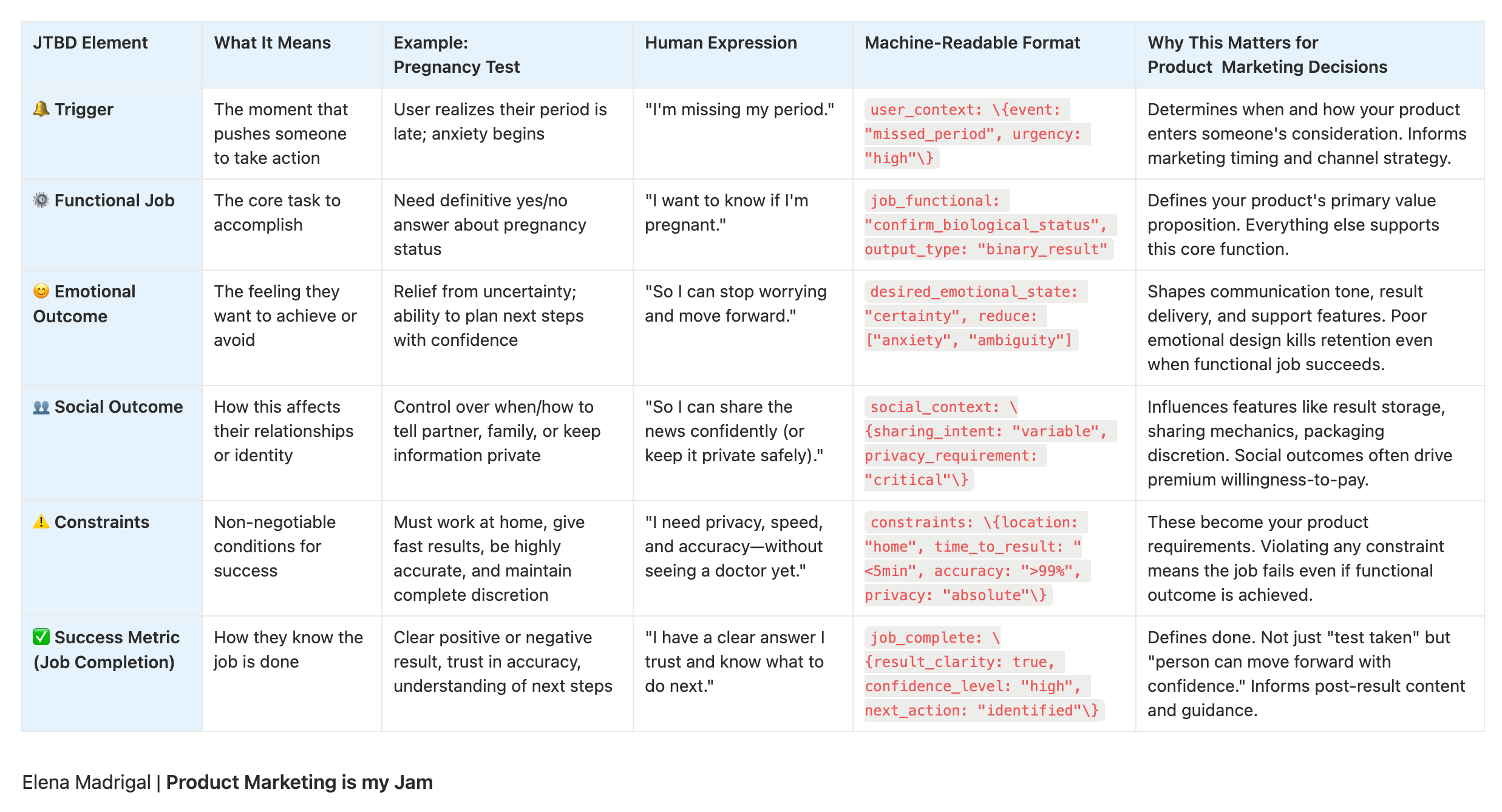
How to use this table
Start with the human expression, that’s your customer research. Then translate it into structured parameters that both your team and AI systems can act on.
For your product team: Use these job elements to design features, write copy, and structure your information architecture. When you know the constraint is “absolute privacy,” you don’t just add a privacy toggle, you rethink packaging, result storage, and every touchpoint.
For the agentic economy: These same parameters become your product’s metadata. When a shopping agent queries “user needs reassurance + rapid clarity about pregnancy status,” your structured job data gives it reason to surface your product over competitors with identical functional specs but no contextual fit.
This is how brand trust and context translate into algorithmic visibility.
Remember: Personas are the silhouette, intent is the motion. The job is the heartbeat.
When you design around personas, you talk at people.
When you design around jobs, you talk to them. And now, to the agents acting on their behalf.
Encode your product for the job it’s hired to do, and you stop marketing to demographics. You start teaching the ecosystem who you serve and why.
That’s how brands stay visible, not just to humans, but to the intelligent systems deciding what humans see next.