

Stop Building Software. Start Building Status Systems
How adding identity to utility creates unbreakable product moats


Ken Sakata has this fascinating video about fashion design where he splits design into first-person (how clothes feel when you wear them) versus third-person (how you look wearing them). Most fashion focuses on third-person; how others see you.
I watched it last week and now I can't stop seeing software through this lens. I realized software products do the opposite: they’re designed almost entirely for first-person use. But I also realized the best, most loved software products do both.
GitHub is a version control system. Classic first-person utility that makes developers more capable. But the contribution graph, the little green squares showing your commit history? That's third-person design. It makes developers look productive to others. And that graph has become one of GitHub's most engaging features.
The pattern is everywhere
Notion went through the exact same evolution. Started as a note-taking app (first-person utility), became a way to signal you're a systems thinker (third-person status). Now people literally sell Notion templates as a job. The utility enabled the identity, but the identity is what scales.
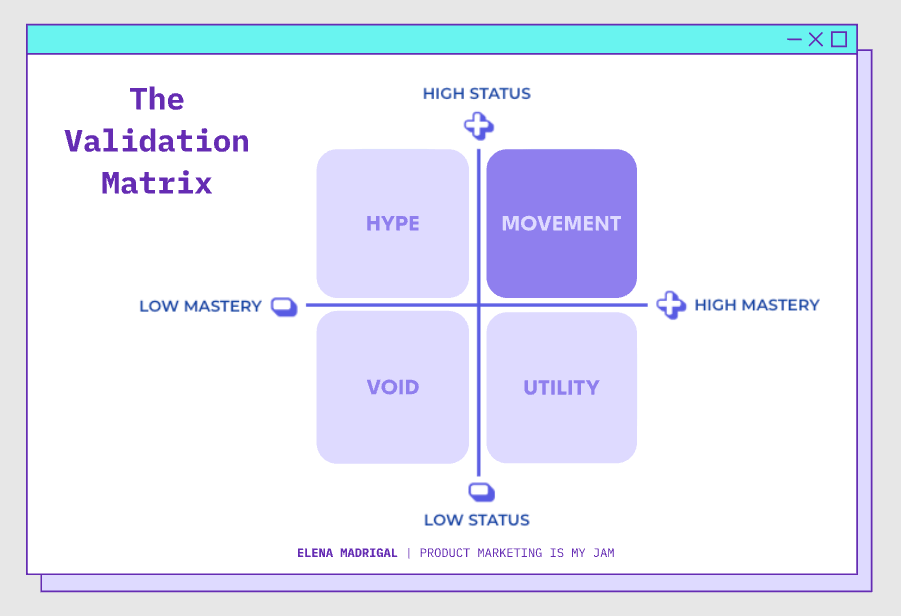
This isn't coincidence. I started mapping products on two axes: first-person utility (does it make you capable?) versus third-person signal (does it make you look capable?). Most successful products start bottom-right: pure utility, no status. Then they deliberately add status layers and migrate top-right.
That top-right quadrant is where products stop being tools and start being movements.
Figma could have stayed a design tool. Instead they made files shareable by default, added profile pages, created a community showcase. Now Figma on your resume means something beyond technical competence; it signals you're plugged into modern design culture.
The failures prove the rule. Google+ launched with pure third-person positioning (join Google's social network!) but zero first-person utility. Status without substance always collapses.
How this creates unbreakable product moats
Once you add status to utility, you're not just serving users anymore. You're serving three distinct tribes, each with different motivations:
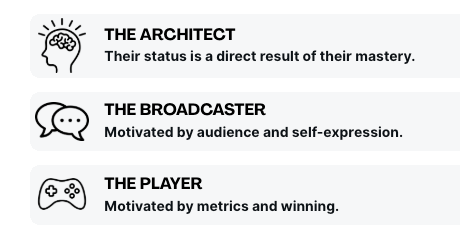
Architects are why developer Twitter exists, building reputation through commentary, not just code. Broadcasters want peer recognition, publishing packages and answering hard Stack Overflow questions to earn respect from people they respect. Players will optimize anything with a metric. They'll grind Leetcode problems not to get better at coding but to hit that ranking.
The same product can serve all three if you design and market them for it. GitHub has rankings for Players, profile READMEs for Broadcasters, sponsorships for Architects.
Introducing Validation-as-a-Service (VaaS)
Traditional SaaS assumes value comes from utility: you pay for features, storage, compute. But Superhuman charges $30/month for email. Nobody needs email that expensive. They're not buying email functionality, they're buying identity. "I'm someone who invests in premium productivity tools."
And this changes your entire business model.
You're not selling software capabilities, you're creating a status system where software access is the membership fee. Your first ten users aren't customers, they're founding citizens who define what status means in your world.
I’m calling this new business model Validation-as-a-Service.
Stop thinking about products as tools. Start thinking about them as identity infrastructure. Your marketing isn't explaining features anymore, it's world-building, establishing what mastery looks like in your domain. Every case study is really saying "this could be you."
The companies that understand this will build the deepest moats.
I've been working through this framework in detail: the validation matrix, growth loops for each user archetype, ethical considerations, the complete playbook. It's all in my new white paper, and it’s not even gated.
Read it here and let me know what do you think:
The Identity Moat: Why the Next Generation of Market-Defining Companies Sells Status, Not Software.