

Strategic Thinking Is Dimensional Thinking
Time horizons. Altitude levels. Once you can see your work in multiple dimensions simultaneously, AI stops being a typist.

If your prompt looks something like: “Help me position this new dashboard feature.”
Of course you will get garbage. You gave it one data point and asked it to extrapolate a strategy.
The problem isn’t the AI. It’s that you’re treating your work like it exists in a single moment, at a single level. Feature drops. You react. You launch it. You move on.
But that’s not how strategic work actually happens. Strategy requires seeing multiple things at once: what’s happening now and what’s building toward later. The micro details and the macro story. The individual release and the narrative it’s part of.
I call this 3D thinking. Two axes: time horizon (now, next, later) and altitude (macro strategy down to micro execution).
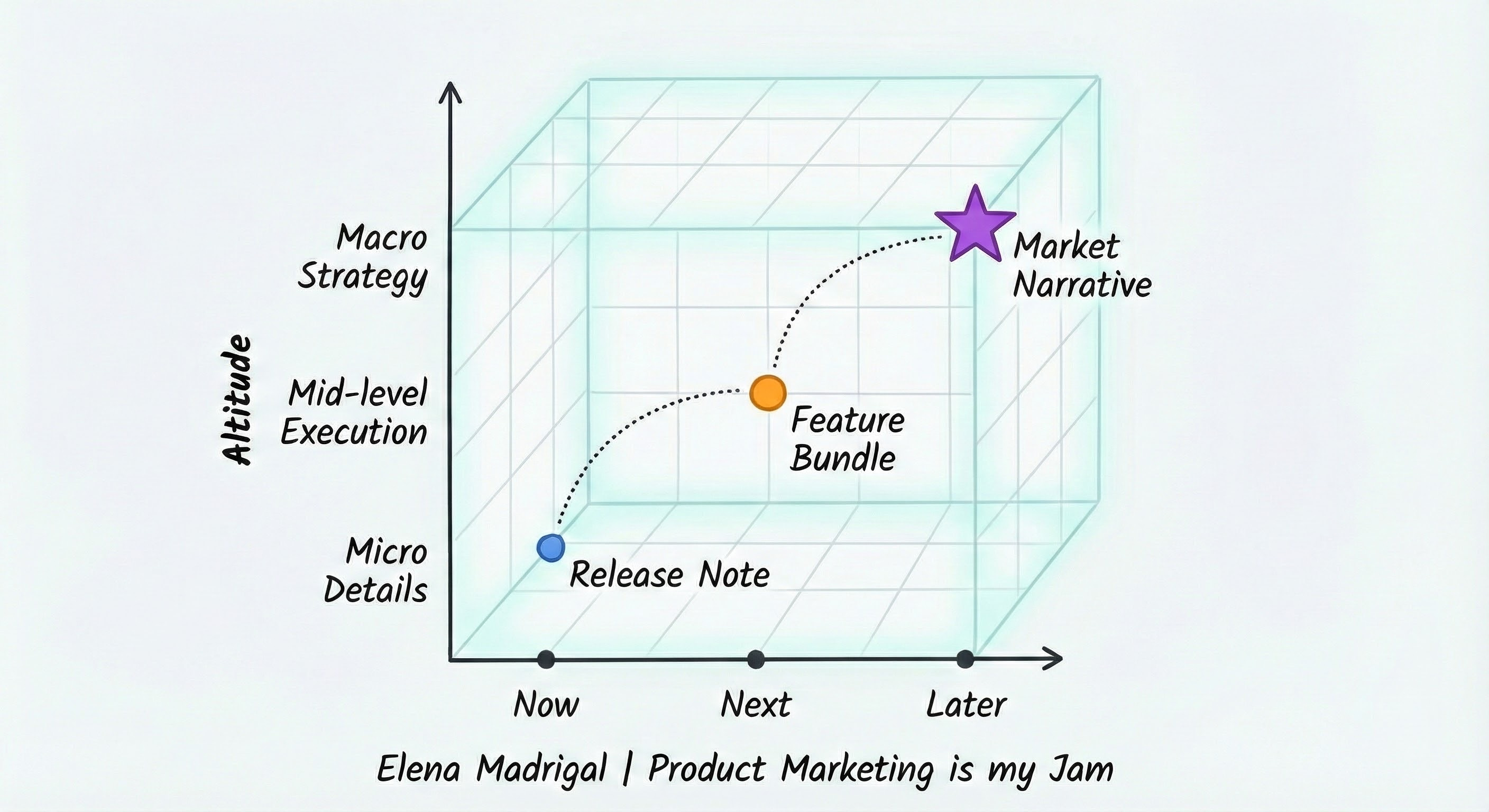
Many PMMs operate in a single square of that grid because they think of themselves as the last step in some sort of automated process of bringing products to market. Go-to-market is not something that belongs to marketing, the same way that revenue doesn’t belong to Sales.
Both concepts belong to everyone in the company. It’s the strategic approach towards each what matters.
As a PMM you might be stuck in “now” at “mid-altitude,” churning out launch tactics for whatever shipped this sprint. And then wonder why nothing feels connected, why every launch feels the same, why the AI can’t help you see the bigger picture.
The AI can’t see the bigger picture because you haven’t drawn it.
Releases Happen on Engineering Time. Launches Happen on Market Time.
Your product team ships something every two weeks. Maybe more. They have to. That’s how software development works. You break big ideas into small chunks, ship them incrementally, iterate fast.
But most of those sprint releases mean nothing to a customer.
A new API endpoint? Doesn’t matter on its own. A settings toggle? Sure, fine. A performance improvement? Cool, I guess.
But three of them together might actually be something. They might solve a problem someone cares about. They might be a reason to pay attention again.
That’s the difference between a release and a launch.
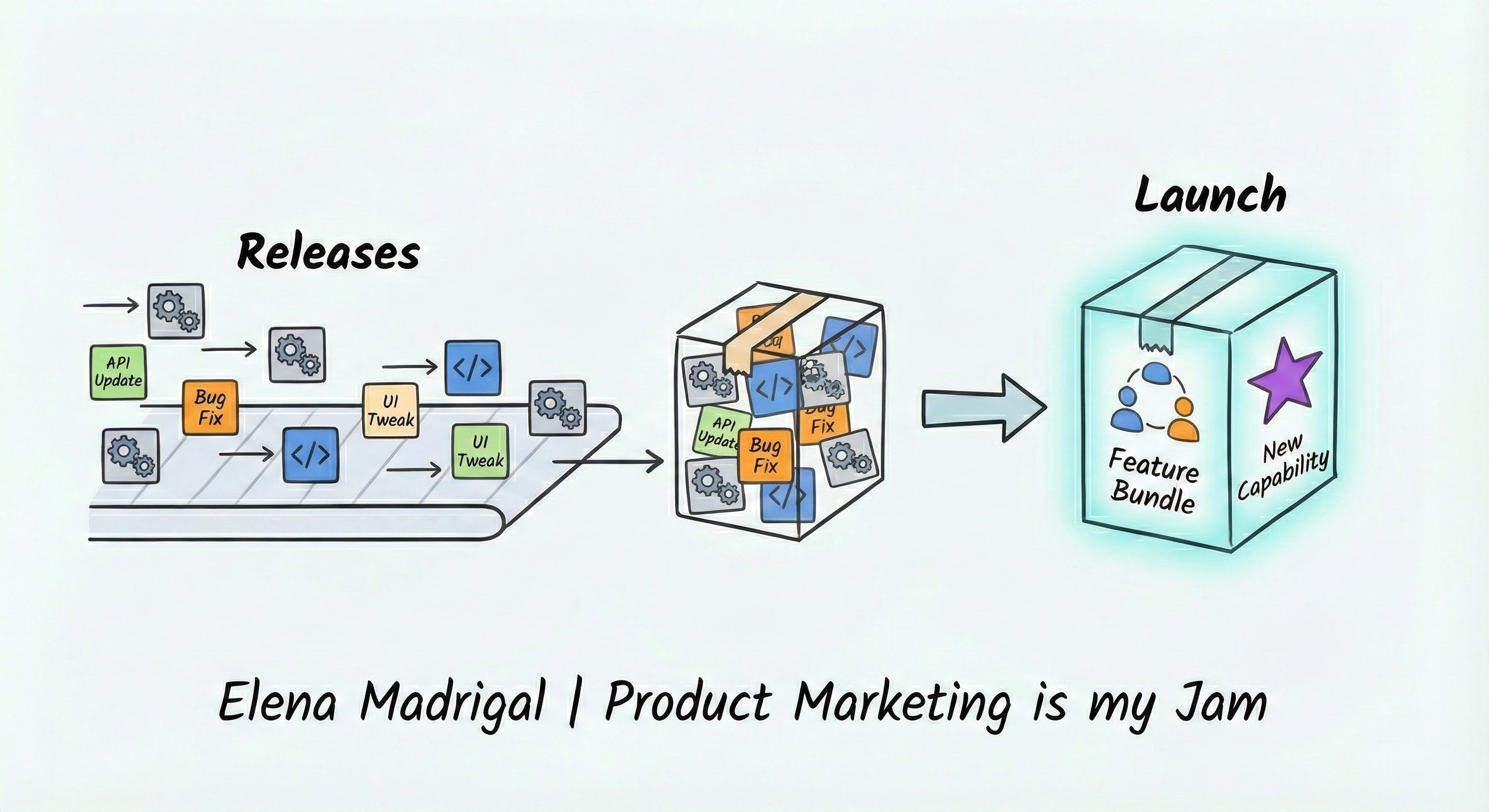
Releases are when code ships. Launches are when value becomes visible to the market.
Your engineering team operates on a sprint cadence. Your marketing should operate on a value cadence. And those two things are almost never synchronized.
If you’re trying to launch every release, you’re just making noise. If you’re waiting for the perfect moment to bundle everything into one big launch, you’re probably missing opportunities to tell smaller stories along the way.
The skill is knowing which releases to bundle, when to bundle them, and what altitude of story to tell when you do.
The Tier System Is How You Make Bundling Decisions
Not every release deserves the same marketing treatment. This should be obvious, but I see teams treat everything like it’s equally important because they don’t have a system for deciding what actually matters.
So here’s one: tier your launches. You can adjust this to your needs, in fact, you must.
Tier 3 is table stakes. The stuff you need to have for the product to work credibly, but nobody’s switching to you because of it. This goes in release notes. Low altitude, present tense. Document it and move on.
Tied 2 is meaningful for people who already use your product. It makes their lives better. It solves a real problem they have. You tell existing customers about this. Mid-altitude story. Retention play.
Tier 1 is significant enough that people outside your current customer base should care. It changes your market position. It’s a reason for someone to reconsider your product even if they dismissed it before. High altitude narrative. Acquisition play.
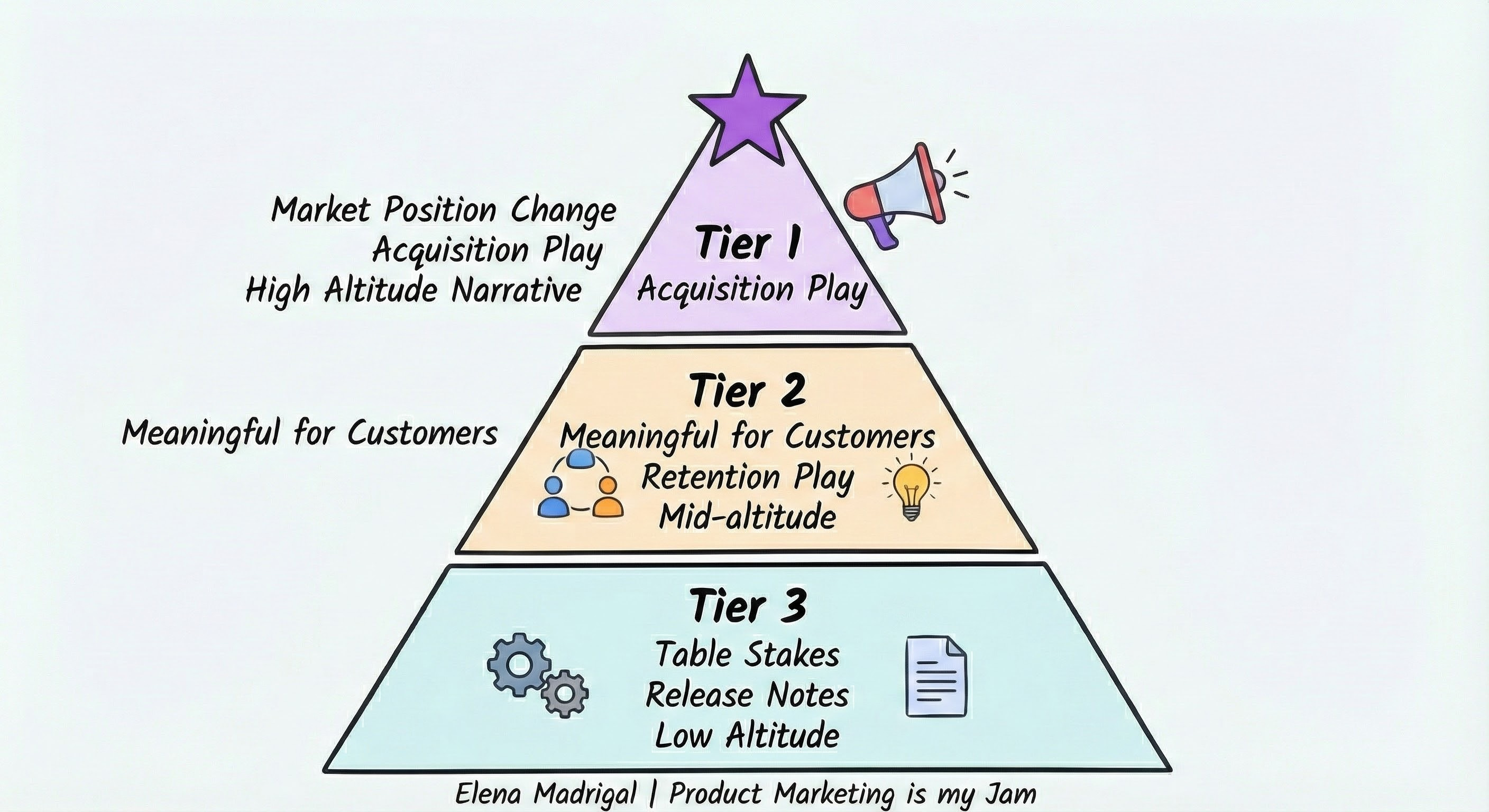
It gets even more interesting when several Tier 3 releases can bundle into a Tier 2 story. Several Tier 2 moments can build into a Tier 1 narrative.
That API endpoint on its own? Tier 3. But that API endpoint plus the settings toggle plus the performance improvement might add up to “we’ve made third-party integrations three times faster and way more reliable.” That’s Tier 2.
And if you’ve shipped four Tier 2 moments over six months that all point in the same direction, you might actually be sitting on a Tier 1 story you haven’t noticed yet.
You can’t see that if you’re only thinking in now at mid-altitude.
Time Horizon Plus Altitude Equals Strategic Context
Put time on one axis (now, next, later) and altitude on the other (macro strategy, mid-level execution, micro details).
Every piece of work you do sits somewhere in that grid.
A single release shipping this week is low altitude, present tense. Probably Tier 3. You document it. Done.
Three releases over the next month might be mid-altitude, short time horizon. Could be Tier 2. You look for the connective tissue. Is there a story here about what these releases enable together?
Everything you’ve shipped over the last quarter, viewed from high altitude, might reveal a Tier 1 narrative you’ve been building without realizing it. That’s longer time horizon, macro strategy. That’s when you step back and ask: what are we actually becoming? What shift in the market are we enabling?
Many product marketers collapse all of this into a single dimension. They see a release, they launch the release. Flat thinking.
Strategic thinking is seeing the whole grid at once. A release in isolation (low altitude, now). The pattern it’s part of (mid altitude, next). The market shift it’s building toward (high altitude, later).
And once you can see that grid, you can describe it.
This Is What AI Actually Needs From You
When you ask an AI to “help with positioning,” you’re asking it to operate with no coordinates. It doesn’t know if this is Tier 1 or Tier 3. It doesn’t know if this is part of a six-month narrative or a standalone moment. It doesn’t know if you’re talking to prospects or existing customers.
So it gives you the most generic mid-altitude, present-tense positioning it can generate. And you’re disappointed because it feels flat.
It feels flat because your prompt was flat and lacking context. Context that only you have because is relevant to your end goal, to your current situation, to what success looks like, to what is the problem you’re trying to solve now that will unlock something else later.
AI needs coordinates. Magic happens when it knows the altitude. It knows the time horizon. It knows the strategic context.
The output is different. Not because the AI suddenly got smarter, but because you gave it a map of the space it’s supposed to be operating in.
You Can’t Outsource the Dimensionality
This is why the “AI will replace PMMs” takes are wrong, by the way.
AI can’t replace strategic thinking. It can only execute within the strategic frame you give it.
If you can’t see your work in 3D, if you can’t tier releases, if you can’t think across time horizons, if you can’t operate at different altitudes depending on what the moment requires, then you’re not doing strategy. You’re doing random execution.
AI can help you write faster, test more angles, explore more messaging variations. But it can’t tell you where you are in the grid. You have to know that first.
The Actual Unlock
So the unlock isn’t “get better at prompting.” It’s “get better at seeing your work in three dimensions.”
When you can do that, when you can look at a release and immediately place it in the time horizon and altitude grid, when you can see how Tier 3s bundle into Tier 2s and Tier 2s build toward Tier 1s, your prompts change completely.
You stop asking AI to figure out the strategy. You give it the strategic context and ask it to help you see the gaps and execute within that context.
And suddenly the output stops feeling flat. Because you’re not asking it to think in one dimension anymore. You’re giving it the full map.
Didn't expect this take on the subject, but it make so much sense, a bit like how in Pilate you connect the micro-movements to the whole flow. Once that 3D picture is drawn, how do you see AI's role in optimising those connections?